
LUMIA INSIGHTS
How Much Does It Cost to Hire Software Developers in 2027? U.S., Latin America, Europe & Asia Compared
Hiring software developers has become a global decision.
A company building an engineering team in 2027 may be comparing a senior developer in the United States with professionals in Brazil, Chile, Poland, Germany, India, or the Philippines.
The difference can represent tens—or even hundreds—of thousands of dollars per hire.
But salary is only part of the equation.
The real question is:
Where can companies find the right combination of technical capability, compensation, communication, time-zone alignment, and long-term scalability?
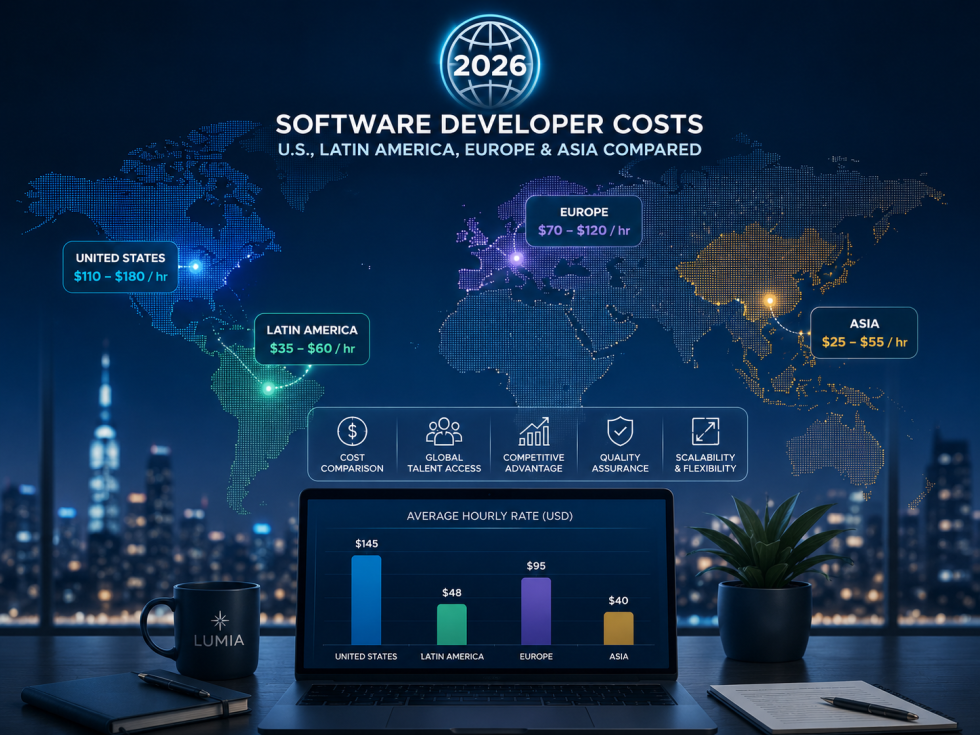
Software Developer Hiring Costs Entering 2027
Current remote compensation data already shows significant differences across global talent markets.
Arc's international salary data places average expected remote developer compensation at approximately $97,000 in the United States, $60,000 in Latin America, $70,000 in Western Europe, $62,000 in Central and Eastern Europe, and $56,000 in Asia. These figures are based on expected salaries reported by remote developers and should be treated as market benchmarks rather than universal salary levels.
| Region | Current Remote Developer Benchmark | 2027 Hiring Perspective |
|---|---|---|
| United States | ~$97K average | Highest overall hiring cost |
| Latin America | ~$60K average | Competitive cost with strong Americas alignment |
| Western Europe | ~$70K average | Mature markets with higher compensation |
| Central & Eastern Europe | ~$62K average | Strong technical ecosystems at moderate cost |
| Asia | ~$56K average | Large talent pools with broad cost variation |
Actual compensation can vary substantially depending on seniority, technology, English proficiency, location, employment model, and specialization.
AI, cloud, cybersecurity, DevOps, data engineering, and other scarce capabilities can command significant premiums.
$97,000 in the United States, $60,000 in Latin America, $70,000 in Western Europe, $62,000 in Central and Eastern Europe, and $56,000 in Asia.
United States: The Highest-Cost Market
The United States remains one of the world's most expensive software talent markets.
The U.S. Bureau of Labor Statistics reported a median annual salary of $135,980 for software developers in May 2025, with the highest 10% earning more than $214,000.
For senior engineers, the real employer cost can be considerably higher.
Salary may be accompanied by:
-
Payroll taxes
-
Healthcare and other benefits
-
Bonuses or equity
-
Recruiting costs
-
Equipment and software
-
Management and operational overhead
A senior U.S.-based engineer can therefore represent a fully loaded annual cost above $250,000, particularly in competitive technology markets.
For strategic roles, that investment may be justified. But companies building larger engineering teams increasingly compare it with global alternatives.
Latin America: Cost Efficiency and Time-Zone Alignment
Latin America has become particularly relevant for North American companies because compensation remains below U.S. levels while many countries offer substantial overlap with U.S. working hours.
Current remote developer expectations average approximately $60,000 per year across the region.
Country-level variation is significant. Deel's 2026 benchmarks, for example, place mid-level developer compensation broadly between approximately $44,000 and $92,000 across markets including Argentina, Brazil, and Chile.
For companies in the United States or Canada, Latin America can therefore combine:
-
Competitive compensation
-
Strong time-zone overlap
-
Growing English proficiency
-
Mature technology communities
-
Easier real-time collaboration
The opportunity is not simply to hire developers for less. It is to access a larger market without creating major operational distance.
Europe: One Region, Very Different Markets
Europe should not be treated as a single talent market.
Western Europe currently averages around $70,000 in expected remote developer compensation, while Central and Eastern Europe averages approximately $62,000.
Germany, for example, shows expected remote developer compensation around $72,900, with senior developers averaging roughly $95,000 in Arc's dataset.
Central and Eastern European markets such as Poland and Romania remain attractive because of their established software engineering ecosystems and relatively competitive compensation.
Europe can be particularly relevant for companies that need technical depth, multilingual teams, or operational proximity to European customers.
Asia: The Broadest Cost Spectrum
Asia offers some of the world's largest technology talent pools—but also some of the greatest variation.
The regional remote developer benchmark is approximately $56,000 annually, but individual markets differ substantially.
In the Philippines, for example, remote developers report average expectations around $41,000, while senior developers average approximately $72,000.
India also offers enormous engineering depth across backend development, cloud, data, DevOps, AI, and enterprise technologies. Current Arc benchmarks for several common software disciplines are broadly around the mid-$40,000 to low-$50,000 range for remote professionals in the country.
The principal trade-off for U.S. companies is often time-zone distance rather than talent availability.
Salary Is Not the Same as Hiring Cost
Comparing salaries alone can produce poor hiring decisions.
Companies should also calculate:
Total Hiring Cost = Compensation + Benefits + Taxes + Recruiting + Compliance + Equipment + Management + Turnover Risk
International employees may also require an Employer of Record, local entity, or another compliant employment structure.
Typical EOR fees can add approximately $300 to $1,000 per employee per month, depending on provider and country.
Contractors can reduce some of those costs, but introduce different questions around continuity, intellectual property, compliance, and long-term retention.
What Will Matter Most in 2027?
The global software market is increasingly becoming less about finding the cheapest developer and more about identifying where a specific capability can be hired most effectively.
A U.S. company may decide to keep technology leadership domestically, build product teams in Latin America, source specialized engineers in Eastern Europe, and use Asian talent for specific engineering functions.
The result is a more distributed model of technology hiring.
The question is no longer:
“Which country has the cheapest developers?”
It is:
“Which talent market gives us the strongest combination of capability, cost, availability, and operational fit?”
That requires more than salary data.
It requires Talent Intelligence.
THE NEXT STEP
Build your engineering team in the right talent markets
Lumia combines Global Talent Acquisition, Technology Talent Intelligence, Executive Search, and IT Staffing to help companies identify where the talent they need exists—and how to hire it effectively.
Instead of limiting a search to one geography, we compare talent markets, compensation, availability, and technical capabilities to build the right hiring strategy.